Speeches
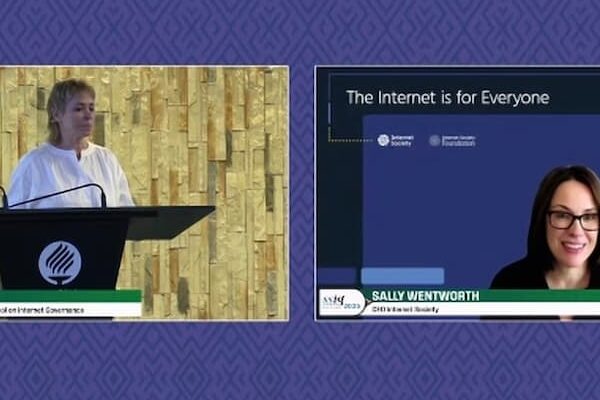
The Internet is for Everyone
How easy to say - how hard to achieve!
Where are we in achieving this noble objective?
The Internet is in
its 11th year of annual doubling since 1988. There are over 44 million
hosts on the Internet and an estimated 150 million users, world wide.
By 2006, the Internet is likely to exceed the size of the global telephone
network, if it has not by that time become the telephone network by virtue
of IP telephony. Moreover, tens of millions of Internet-enabled appliances
will have joined traditional servers, desk tops and laptops as part of
the Internet family. Pagers, cell phones and personal digital assistants
may well have merged to become the new telecommunications tool of the
next decade. But even at the scale of the telephone system is it sobering
to realize that only half the population of Earth has ever made a telephone
call.
It is estimated that
commerce on the network will reach somewhere between $1.8T and $3.2T by
2003. That is only four years from now (but a long career in Internet
years).
The number of users
of Internet will likely reach over 300 million by the end of the year
2000, but that is only about 5% of the world's population. By 2047 the
world's population may reach about 11 billion. If only 25% of the then-world''s
population is on the Internet, that is nearly 3 billion users or ten times
the population estimated at the end of the next year.
As high bandwidth
access becomes the norm, through digital subscriber loops, cable modems
and digital terrestrial and satellite radio links, the convergence of
media available on the Internet will become obvious. Television, radio,
telephony and the traditional print media will find counterparts on the
Internet - and will be changed in profound ways by the presence of software
that transforms the one-way media into interactive resources, shareable
by many.
The Internet is proving
to be one of the most powerful amplifiers of speech every invented. It
offers a global megaphone for voices that might otherwise be heard only
feebly, if at all. It invites and facilitates multiple points of view
and dialog in ways unimplementable by the traditional, one-way, mass media.
The Internet can
facilitate democratic practices in unexpected ways. Did you know that
proxy voting for stock shareholders is now commonly supported on the Internet?
Perhaps we can find additional ways in which to simplify and expand the
voting franchise in other domains, including the political, as access
to Internet increases.
The Internet is becoming
the repository of all we have accomplished as a society. It is becoming
a kind of disorganized Boswell of the human spirit. Be thoughtful in what
you commit to email, news groups, and other media - it may well turn up
in a web search some day. Shared databases on the Internet are acting
to accelerate the pace of research progress, thanks to online access to
commonly accessible repositories.
The Internet is moving
off the planet! Already, interplanetary Internet is part of the NASA Mars
mission program now underway at the Jet Propulsion Laboratory. By 2008
we should have a well-functioning Earth-Mars network that serves as a
nascent backbone of an interplanetary system of Internets - InterPlaNet
is a network of Internets! Ultimately, we will have interplanetary Internet
relays in polar solar orbit so that they can see most of the planets and
their interplanetary gateways for most if not all of the time.
The Internet is for
everyone - but it won't be if it isn't affordable by all who wish to partake
of its services, so we must dedicate ourselves to making Internet as affordable
as other infrastructure so critical to our well-being. While we follow
Moore's Law to reduce the cost of Internet-enabling equipment, let us
also seek to stimulate regulatory policies that take advantage of the
power of competition to reduce costs.
The Internet is for
everyone, - but it won't be if Governments restrict access to it, so we
must dedicate ourselves to keeping the network unrestricted, unfettered
and unregulated. We must have the freedom to speak and the freedom to
hear.
The Internet is for
everyone - but it won't be if it cannot keep up with the explosive demand
for its services, so we must dedicate ourselves to continuing its technological
evolution and development of the technical standards the lie at the heart
of the Internet revolution. Let us dedicate ourselves to the support of
the Internet Architecture Board, the Internet Engineering Steering Group,
the Internet Research Task Force and the Internet Engineering Task Force
as they drive us forward into an unbounded future.
The Internet is for
everyone - but it won't be until in every home, in every business, in
every school, in every town and every country on the Globe, Internet can
be accessed without limitation, at any time and in every language.
The Internet is for
everyone - but it won't be if it is too complex to be used easily by everyone.
Let us dedicate ourselves to the task of simplifying Internet's interfaces
and to educating all who are interested in its use.
The Internet is for
everyone - but it won't be if legislation around the world creates a thicket
of incompatible laws that hinder the growth of electronic commerce, stymie
the protection of intellectual property, and stifle freedom of expression
and the development of market economies. Let us dedicate ourselves to
the creation of a global legal framework in which laws work across national
boundaries to reinforce the upward spiral of value that Internet is capable
of creating.
The Internet is for
everyone - but it won't be if its users cannot protect their privacy and
the confidentiality of transactions conducted on the network. Let us dedicate
ourselves to the proposition that cryptographic technology sufficient
to protect privacy from unauthorized disclosure should be freely available,
applicable and exportable. Moreover, as authenticity lies at the heart
of trust in networked environments, let us dedicate ourselves to work
towards the development of authentication methods and systems capable
of supporting electronic commerce through the Internet.
The Internet is for
everyone - but it won't be if parents and teachers cannot voluntarily
create protected spaces for our young people for whom the full range of
Internet content may be inappropriate. Let us dedicate ourselves to the
development of technologies and practices that offer this protective flexibility
to those who accept responsibility to provide it.
The Internet is for
everyone - but it won't be if we are not responsible in its use and mindful
of the rights of others who share its wealth. Let us dedicate ourselves
to the responsible use of this new medium and to the proposition that
with the freedoms Internet enables comes a commensurate responsibility
to use these powerful enablers with care and consideration. For those
who choose to abuse these privileges, let us dedicate ourselves to developing
the necessary tools to combat the abuse and punish the abuser.
I hope Internauts
everywhere will join with the Internet Society and like-minded organizations
to achieve this easily stated but hard to achieve goal. As we near the
milestone of the third millennium, what better theme could we possibly
ask for than making the Internet the medium of the new millennium?
Internet IS for everyone
- but it won't be unless WE make it so.
Given by Vint
Cerf at Computers, Freedom, and Privacy on April 7, 1999.
|